
JVC Car Audio History: From Its 1927 Roots to Connected Driving in 2026
JVC car audio sits within one of the longest histories in consumer electronics. The company began in Japan in 1927, decades before smartphone integration or floating touchscreen receivers. Its later automotive story follows the way people have carried music with them: cassettes, CDs, digital files, wireless streaming, and the connected dashboard.
By 2026, a JVC receiver can be much more than a replacement radio. Depending on the model, it can connect a compatible phone, display navigation apps, support vehicle cameras, provide audio adjustments, and work with interfaces that retain selected factory features.
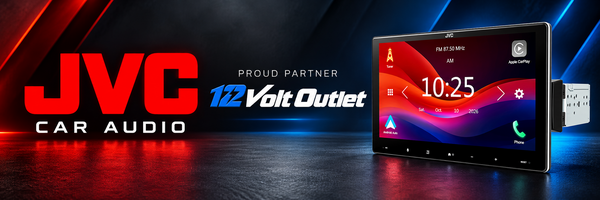
We at 12 Volt Outlet are happy and proud to partner with JVC. We love what a thoughtful receiver upgrade can do for everyday driving. Better access to music, a more useful screen, and the right connections for the rest of the system can make an older vehicle feel much more enjoyable to use.
Here is the story behind JVC’s automotive products, from the company’s original roots through the receivers and related equipment that matter in 2026.
1927: JVC’s Story Begins in Yokohama
JVC was established in Yokohama, Japan, in 1927 as the Japanese subsidiary of the American Victor Talking Machine Company. Its early business involved phonographs and records, connecting the equipment used to play music with the recordings themselves.
That date marks the company’s founding, rather than the beginning of a car stereo product line. JVC’s automotive business developed later as consumer electronics and in-vehicle entertainment evolved.
The broader heritage is still relevant. JVC grew around technologies for recording, reproducing, and presenting sound and images. A modern multimedia receiver brings those interests together in a dashboard-sized product.
The Mid-Century Years and 1976: A Wider Electronics Heritage
Over the following decades, JVC developed products across audio and video. A particularly well-known milestone came in 1976 with the introduction of its VHS-format video recorder. VHS became a major part of home entertainment history and helped make JVC a familiar consumer name.
For a car audio customer, that background explains why the brand’s identity extends beyond amplifiers and speakers. JVC has worked across the playback experience, including the source, controls, display, and audio signal.
When choosing a car receiver, those pieces are inseparable in everyday use. The unit needs to sound good, connect to the sources you use, and provide controls that make sense in the vehicle. The specification sheet is only part of that experience.
The Cassette and CD Era: Music Collections Move Into the Dashboard
JVC’s archived automotive products document the transition from cassette playback to multi-disc and digital systems. Cassette receivers such as the KS-FX270 could control an optional 12-disc CD changer, allowing owners to add another music source without abandoning their tapes.
That kind of expandability was a meaningful feature when a music library meant physical media. The receiver served as the center of a system that might include an external changer, additional amplification, and replacement speakers.
The later KS-FX490 archive illustrates another step in the transition, with control for an optional MP3-compatible CD changer. Different formats overlapped rather than disappearing overnight. JVC’s product history reflects those changing habits.
It is useful context for today’s shopper. A receiver should support the media you actually want to use. If your CDs still matter to you, check for a disc mechanism. If most of your listening comes from a phone, a digital media receiver may provide a better match to your priorities.
Around 2000: El Kameleon Makes the Receiver Face Part of the Story
One of JVC’s most distinctive automotive designs was El Kameleon. In JVCKENWOOD’s design archive, the company’s designers recall the series developed around 2000 and its face that turned black when switched off.
JVC’s archived KD-LX1 and related products show how that concept worked: the receiver’s illuminated controls and display appeared during operation, while the inactive face looked far more discreet. El Kameleon II models continued the idea, with the KD-LX50 adding a voice-control feature.
The design made the receiver’s appearance part of its appeal. For enthusiasts, it was a recognizable example of JVC doing something different with the interface, at a time when rows of buttons and prominent knobs were common.
Modern receivers solve different problems, but the underlying question remains relevant: how should a dashboard component look and behave when you use it every day?
The 2000s: Car Stereos Become Multimedia Centers
As displays and digital playback became more important, JVC expanded its automotive multimedia offerings. Its annual report for the fiscal year ended March 2006 highlighted the KD-AVX1, a DVD/CD receiver with a built-in 3-inch LCD screen, as a successful product in Europe and the United States.
The model represents an important step between the traditional radio face and the larger screens familiar today. A receiver could present visual information as well as play music, changing both the controls and the space available for menus.
JVC’s archives also include navigation receivers, while its later catalogs document increasing support for portable devices and wireless connections. The role of the receiver was expanding from playing a selected disc to managing more of the in-car entertainment experience.
This history helps explain why a receiver upgrade can affect the entire system. The source unit determines which connections are available, how external amplifiers receive their signal, and which adjustments can be made before the music reaches the speakers.
2008 and 2011: JVC and Kenwood Come Together
In October 2008, JVC and Kenwood established a joint holding company as part of their management integration. The business subsequently adopted the JVCKENWOOD Corporation name in 2011, followed by the merger of its operating companies that October.
JVC and Kenwood continued as distinct product brands within the combined organization. For shoppers, that means the corporate relationship does not make every JVC receiver identical to a Kenwood model. Controls, features, product positioning, and specifications should be compared individually.
It also matters when reading historical company documents. Kenwood’s earlier automotive milestones belong to Kenwood’s history, while JVC’s product story has its own sequence. The shared corporate name should not blur those separate roots.
The 2010s: Smartphones Change What Drivers Expect
During the 2010s, the phone became an increasingly important music source and companion to the receiver. Bluetooth calling and streaming, USB connections, and app-oriented features changed the everyday reasons people upgraded their radios.
JVC’s 2016 U.S. catalog featured the KW-V820BT with Apple CarPlay. That is a concrete milestone in the brand’s move toward a receiver interface built around compatible smartphone functions. Subsequent catalogs show the continuing expansion of connected multimedia products.
CarPlay and Android Auto are especially relevant because they provide supported navigation, communication, and audio functions through a compatible vehicle display. Availability depends on the receiver, phone, software, and connection method. A product that supports wired use should not be assumed to support wireless use as well.
From a buyer’s perspective, the change is straightforward: the receiver can make existing phone-based habits easier to access in the vehicle. That is often the main reason for an upgrade, even before adding amplifiers or replacing speakers.
2020: The KW-Z1000W and the Large Floating Display
JVC’s 2020 catalog documented the KW-Z1000W with a 10.1-inch high-definition display and wired or wireless support for Apple CarPlay and Android Auto. Its adjustable floating-screen design allowed a larger display to sit in front of the receiver chassis.
The format changed what was possible when a traditional in-dash screen size felt limiting. It also made physical fitment more important. A floating display has to clear nearby vents, switches, trim, and the driver’s view of necessary controls.
The correct installation is about the whole dashboard. Screen size alone cannot tell you whether a receiver is a good match. The chassis depth, screen position, required mounting parts, and retention of vehicle functions all need to be considered.
2026: Larger Screens, More Cameras, and Direct-Replacement Systems
JVC’s U.S. lineup in 2026 includes the KW-Z1001W, with a 10.1-inch HD floating display. Its listed features include wired and wireless smartphone integration, four camera inputs, support for compatible HD cameras, and optional iDatalink Maestro integration.
The KW-Z1000AW takes a different installation approach within JVC’s Direct Replacement category. It uses a remotely mounted receiver chassis and compatible Maestro APX parts to replace supported factory displays with a larger floating screen. The required interface, harness, and vehicle-specific parts are part of the system plan.
This is an important development because many modern dashboards do much more than hold a radio. Vehicle settings, climate information, factory amplifiers, and steering-wheel controls can be tied into the original equipment. Replacing that equipment calls for a supported integration path.
Direct Replacement does not mean universal fit. Confirm the exact vehicle, trim, factory equipment, and required parts before ordering. Likewise, optional cameras and interfaces should be included in the budget when their functions are part of the goal.
In 2026, JVC is 99 years into its company history. Its current automotive products show how far the receiver has developed from a place to load a tape or CD into a connection point for music, phones, displays, and selected vehicle functions.
Understanding the JVC Car Audio Range
Single-DIN and Traditional In-Dash Receivers
A large touchscreen is not the right answer for every vehicle. JVC also lists traditional in-dash receivers, including CD and digital media options. These can make sense when space, appearance, budget, or a preference for physical controls drives the decision.
Compare the features you will use: Bluetooth, USB playback, radio options, display readability, and the connections for external amplification. A simpler receiver with the right capabilities can be a satisfying upgrade.
Multimedia and Floating-Screen Receivers
JVC’s multimedia products cover different screen formats and feature combinations. Depending on the model, those can include CarPlay, Android Auto, camera support, HDMI connections, HD Radio, and compatibility with optional satellite-radio equipment.
Make a short priority list before comparing them. Decide whether wireless phone integration matters, whether you need a CD or DVD mechanism, how many cameras you intend to connect, and which factory functions you want to retain. This keeps the purchase focused on the way you will use the vehicle.
Audio Adjustments and External Amplifiers
Many JVC receivers include audio-adjustment tools such as equalization, crossover settings, and time alignment, with the exact tools depending on the model. These functions help shape the signal around the speakers and seating position.
Equalization changes the balance of frequency ranges. Crossovers divide the work between speakers and subwoofers. Time alignment can compensate for differences in speaker distance. They are useful controls, but effective setup begins with correct wiring, sound mounting, and appropriate equipment choices.
If you plan to add amplifiers, examine the receiver’s preamp outputs and supported system configurations. The number of output pairs, their functions, and the available adjustments can affect what the rest of the installation needs.
JVC Speakers, Amplifiers, and Marine or Motorsports Equipment
Although receivers are a prominent part of its identity, JVC’s car entertainment range also includes speakers, subwoofers, and amplifiers. Its marine and motorsports category provides additional products intended for more demanding environments.
Models such as the compact DRVN amplifiers are worth considering where available space is limited. Environmental ratings and installation requirements are model-specific, so compare the exact product rather than treating all JVC amplifiers as interchangeable.
A complete upgrade may begin with the receiver and expand later. Planning the signal connections, channels, and future speaker layout early can make that progression more straightforward.
JVC Car Audio History at a Glance
- 1927: JVC’s corporate story begins in Yokohama, Japan.
- 1976: Its VHS introduction becomes a major consumer-electronics milestone.
- Cassette and CD years: Archived receivers illustrate support for multiple physical-media sources.
- Around 2000: El Kameleon gives the car receiver a distinctive disappearing-display design.
- Mid-2000s: Products such as the KD-AVX1 expand dashboard multimedia.
- 2008–2011: JVC and Kenwood integrate under the JVCKENWOOD organization.
- 2016: The KW-V820BT appears in JVC’s U.S. catalog with Apple CarPlay.
- 2020: The KW-Z1000W brings a 10.1-inch floating HD display to the catalog.
- 2026: Current receivers include larger-screen and vehicle-specific integration approaches.
Why 12 Volt Outlet Is Proud to Partner With JVC
We appreciate how useful a well-chosen JVC upgrade can be. Customers may come in thinking about a bigger screen, but the conversation often includes phone connectivity, camera needs, factory controls, speaker performance, and future plans for the system.
Those are the details we enjoy helping you work through. A receiver should fit both the dashboard and the way you use the vehicle. We want you to understand what the selected model includes and which additional parts your installation requires.
We at 12 Volt Outlet are happy to partner with JVC because the brand gives drivers several ways to modernize their listening experience. Whether you prefer a straightforward radio replacement or a more connected multimedia setup, the right choice should make your daily routine more enjoyable.
JVC Car Audio FAQs
When was JVC founded?
JVC was established in Yokohama, Japan, in 1927. Its car audio products came later as part of a wider audio and video electronics business.
Are JVC and Kenwood the same company?
Both brands are part of JVCKENWOOD. Their management integration began in 2008, followed by the operating-company merger in 2011. Individual products still need to be compared by their own features and specifications.
Do all JVC car stereos have Apple CarPlay and Android Auto?
No. Support varies by model, and wired and wireless connections are separate features to verify. Traditional in-dash receivers may offer Bluetooth and USB without either smartphone interface.
Will a JVC floating-screen receiver fit my vehicle?
Fitment depends on the receiver, dashboard, mounting parts, screen clearance, and factory equipment. Direct Replacement products also require a supported vehicle and the appropriate integration components.
Can I keep my steering-wheel controls with a JVC receiver?
Often, a compatible receiver and the correct vehicle interface can retain them. The necessary parts and available functions depend on the vehicle and the selected receiver.
Find Your Next JVC Upgrade at 12 Volt Outlet
JVC’s history connects generations of music and media technology with the dashboard. From cassette and CD expansion to El Kameleon, multimedia receivers, and connected screens, the brand has continued to adapt to the way people use their vehicles.
We at 12 Volt Outlet are proud to partner with JVC and excited to help you choose your next upgrade. Explore our JVC car audio selection and tell us about your vehicle, phone, and system goals. We will help you narrow the choices to the equipment and features that make sense for your drive.