
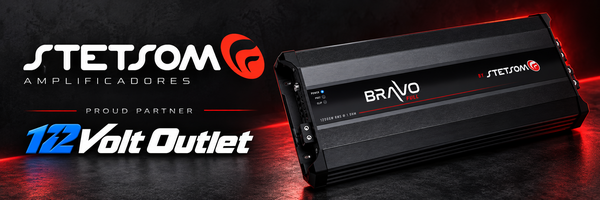
Stetsom Amplificadores History: From Brazil in 1989 to Car Audio in 2026
Stetsom amplifiers have a history rooted in Brazil’s automotive sound industry. The company began in 1989 and grew from modest booster amplifiers into a manufacturer of powerful automotive amplifiers, signal processors, power supplies, and related equipment. Its development connects everyday car audio with the demanding world of high-output systems.
If you have searched for Stetsom amplificadores, you are looking at the Portuguese wording for Stetsom amplifiers. The name points back to the brand’s Brazilian roots and to the product category at the center of its identity.
We at 12 Volt Outlet are happy and proud to partner with Stetsom. We love the enthusiasm this brand brings to car audio. For customers planning a serious bass system or a more ambitious multi-amplifier build, Stetsom offers equipment that deserves a closer look—and a properly matched system around it.
1989: Stetsom Begins in Presidente Prudente, Brazil
Stetsom began operating in 1989 in Presidente Prudente, in Brazil’s state of São Paulo. Its early story includes the AMX-5, a two-channel booster amplifier, and a very small initial workforce.
The company’s later reputation for high power developed from those simpler beginnings. The first chapter was about adding amplification to the automotive systems of its time.
That progression makes the history interesting. A brand associated today with substantial output started with a much more basic product, then expanded as technology and customer expectations changed.
The 1990s: AMX, Sea Power, and the CL Line
Stetsom’s retrospective interview published for its 25th anniversary identifies the AMX-10 in 1992 and the Sea Power Line in 1994 as early milestones. The Sea Power products used aluminum-profile construction, giving the growing amplifier range a new physical identity.
The company also describes a transition to MOSFET amplifier technology during the 1990s. In 1999, it introduced the CL booster line, which became an important part of its broader consumer business.
This period illustrates two needs that still coexist in car audio: accessible upgrades and more capable systems. The customer looking for a simple improvement and the enthusiast planning a larger build may start with very different budgets, but both need equipment suited to the task.
It also helps explain why Stetsom’s history should not be reduced to the biggest amplifier in its catalog. Its development included products for everyday use as well as the higher-output equipment that later drew attention.
The 2000s: Exports, More Product Categories, and Competition Recognition
Stetsom reports making its first export to Argentina in 2000. In 2002, it added an automotive antenna operation, broadening a business previously focused mainly on amplification. Crossovers, mixers, and other accessories became part of its expanding range.
Its corporate history identifies a 2007 SPL world-record achievement in the United States as a turning point in international recognition. That is a historical milestone reported by the company, rather than a claim that every Stetsom amplifier will deliver a particular competition result.
SPL stands for sound pressure level. In competition, the complete installation is developed around the event’s rules and measurement conditions. Amplifier capability is one part of that system, alongside the drivers, enclosure, vehicle, and electrical supply.
For a daily driver, the target may be very different. You may want stronger bass at a comfortable listening level, more clean output, or better control of the existing speakers. A brand’s competition history can be interesting without making a competition-style installation the right choice for everyone.
2014–2016: Amplification Becomes Part of a Larger System
By its 25th anniversary in 2014, Stetsom was discussing a broader mix of products. Its announcements included Vision Colors amplifiers, the STX2496 processor, and a 24-volt VS300.2 Truck amplifier for appropriate commercial-vehicle applications.
The company also received recognition in Brazil’s automotive aftermarket, reporting Marca Brasil awards for amplifier and antenna categories. Its later power-supply announcement referred to awards in both 2014 and 2015.
In May 2015, Stetsom announced the Vulcan 1K EQ amplifier. The release specified different RMS output figures at 12.6 and 13.8 volts, providing a useful illustration of something amplifier buyers should always examine: the conditions behind a power rating.
A wattage figure is more meaningful when the supply voltage, speaker impedance, and measurement conditions are known. Comparing numbers from different conditions can create an inaccurate impression of how two amplifiers will behave in the same vehicle.
Stetsom’s 2016 international catalog showed how wide the supporting range had become. Alongside amplifiers, it documented processors, crossovers, controls, and power-related equipment. This was a manufacturer addressing more of the system surrounding the amplifier.
2018: A Documented Manufacturing-Quality Milestone
Stetsom announced that it received ISO 9001:2015 certification in February 2018 after implementing a quality-management system across its internal processes.
That belongs in the company’s history as a manufacturing and organizational milestone. A quality-management certification addresses processes; it is separate from the output, sound, or suitability of an individual amplifier model.
For the customer, the practical questions remain concrete: which product fits the system, what its published specifications say, and how it will be installed and supported.
The 2020s: Amplifiers, DSP, and More System Control
Stetsom’s 2022 catalog documented multiple processor options, including STX2448 and STX2848 variants. Its current product information continues that emphasis on signal control alongside amplification.
The standard STX2448 provides two audio inputs and four independently configurable outputs. Its tools include equalization, crossovers, delay, phase inversion, and limiting. The separate STX2448 Floating model adds a different feature set, including high-level inputs and additional processing options.
This is an important part of the modern Stetsom story. As systems become more capable, installers need ways to distribute the signal, define what each speaker plays, and control levels throughout the installation.
A processor does not automatically make a system sound good. It provides tools that an installer can use to match the equipment to the vehicle and the listening goal. Correct setup is what makes those tools valuable.
Stetsom Amplifiers in 2026: Understanding the BRAVO Families
By October 2026, Stetsom has 37 years of company history behind it. Its published range includes BRAVO amplifiers for different applications, along with processors and supporting accessories. The differences between product families are especially important when choosing an amplifier.
BRAVO BASS: Amplification for Low Frequencies
As the name suggests, BRAVO BASS products focus on bass applications. These amplifiers should be evaluated for the intended subwoofer system, including output at the final wired impedance and the available low-frequency controls.
For example, Stetsom publishes the BRAVO BASS 3K as a mono amplifier with different power figures at different loads. Its stated frequency range is intended for bass use. A bass amplifier should not be chosen to drive a full-range speaker system simply because its power rating looks attractive.
The subwoofer and enclosure remain central to the result. An amplifier cannot make an unsuitable enclosure behave like the correct one, and more power cannot solve every acoustic problem. Start with the intended bass system, then choose the amplifier to support it.
BRAVO FULL: A Different Frequency-Range Purpose
Stetsom positions BRAVO FULL amplifiers for a broader range of driver applications. It lists the BRAVO FULL 8000 2-ohm model with a 10 Hz–12 kHz frequency response and provides different RMS ratings at 12.6 and 14.4 volts.
That example makes the need to read the specifications clear. The word “full” in a family name should not replace checking the actual frequency range of the specific amplifier. The driver, crossover plan, and required bandwidth must all agree.
A powerful mono amplifier can be part of a system using several speaker types, but those drivers still need appropriate filtering and load management. Tweeters, midranges, and woofers cannot simply be connected together without a plan for which frequencies each will receive.
BRAVO BASS FLEX: More Flexibility in Supported Loads
The BRAVO BASS FLEX 3K introduces another approach. Stetsom describes automatic impedance detection and specifies an operating load range from 0.5 to 2 ohms. Its published frequency response is 5–200 Hz, keeping its role firmly focused on subwoofers.
That supported range can give a system builder more options when choosing and wiring subwoofers. It does not mean every Stetsom amplifier supports the same loads. The FLEX model’s specifications must be kept separate from those of conventional BRAVO BASS or BRAVO FULL products.
Always check the current manual for the exact model and version. Similar names can describe amplifiers with materially different output capabilities, frequency ranges, and installation requirements.
Why Electrical Planning Matters With High-Power Amplifiers
An amplifier’s output depends on the electrical energy available to it. In a demanding installation, the charging system, battery arrangement, cable sizing, protection, grounding, and operating voltage all belong in the plan.
This is especially relevant when comparing high-power Stetsom amplifiers. A compact chassis can still represent a substantial electrical load. Physical size does not tell you how easy it will be to support the amplifier in a particular vehicle.
Review the manufacturer’s recommendations with a qualified installer and account for the complete system. The right amplifier is one that suits the speakers and the available electrical infrastructure, with appropriate upgrades included where necessary.
Stetsom’s power-supply and charger products reflect this wider system perspective. Products such as BRAVO CHARGER units serve specific power-management roles. They should be selected according to their documented operating modes and application, rather than treated as interchangeable accessories.
Power, Signal Quality, and Tuning Work Together
Strong output is useful when the rest of the system can use it effectively. Signal quality, gain structure, crossover settings, and enclosure design all affect the performance you hear.
Gain is an input-sensitivity adjustment. It is used to match the amplifier to the source signal; it does not create additional rated amplifier power. Excessive gain or an already-distorted input can undermine the result even when the amplifier and speakers are capable.
Crossovers assign appropriate frequency ranges to each driver. A processor’s delay and phase tools help the different sections work together. Limiting can be part of a carefully configured control strategy, but it depends on correct settings and knowledge of the connected equipment.
For a music system, we want the bass, midrange, and high frequencies to support each other. A well-balanced installation can remain enjoyable across different songs and volume levels. That is a more useful everyday goal than focusing on one number alone.
Choosing a Stetsom Amplifier for Your Vehicle
Start with the job you want the amplifier to do. Is it powering one subwoofer, several subwoofers, a midbass section, or another part of a larger installation? That answer determines the required frequency range and helps narrow the product family.
Next, establish the final speaker load. Voice-coil configuration and series or parallel wiring affect the impedance presented to the amplifier. The amplifier must support that final load under the intended operating conditions.
Then compare RMS output at the relevant voltage and impedance with the needs of the connected drivers. Include enclosure design and intended use in the conversation. A power rating by itself is not a complete system recommendation.
Finally, confirm dimensions, mounting space, ventilation, controls, signal connections, and the electrical support required. Planning these details before purchase helps avoid a collection of individually impressive products that do not work well together.
At 12 Volt Outlet, we are happy to help you work through those choices. Bring the model numbers of the equipment you already own, the vehicle information, and a clear idea of what you want to improve.
Stetsom History at a Glance
- 1989: Stetsom begins operating in Brazil.
- 1992–1994: AMX-10 and Sea Power Line products mark early expansion.
- 1999: The CL booster line becomes part of the company’s development.
- 2000–2002: Exports and an automotive antenna operation broaden the business.
- 2007: Stetsom identifies a U.S. SPL record achievement as an international milestone.
- 2014–2016: Anniversary-era releases and the international catalog show a broader system-equipment range.
- 2018: The company announces ISO 9001:2015 certification.
- 2026: BRAVO amplifier families and STX processing illustrate the brand’s current direction.
Why 12 Volt Outlet Is Happy to Partner With Stetsom
We love the energy of car audio enthusiasts who have a clear idea of what they want their system to do. Stetsom gives those customers plenty to explore, from bass-focused amplification to processors and supporting equipment.
What excites us most is helping turn that enthusiasm into a sensible equipment plan. The goal may be stronger bass in a daily driver or a much more involved custom system. Either way, the right match between the amplifier, speakers, enclosure, and vehicle matters.
We at 12 Volt Outlet are proud to partner with Stetsom because it brings a distinctive Brazilian amplifier history and a wide range of system-building possibilities to our customers. We want you to enjoy the result every time you listen.
Stetsom Amplifier FAQs
Where is Stetsom from?
Stetsom is a Brazilian brand based in Presidente Prudente, São Paulo. Its company history began in 1989.
What does “Stetsom amplificadores” mean?
“Amplificadores” is Portuguese for “amplifiers.” It describes the product category rather than a separate brand or a specific amplifier series.
What is the difference between BRAVO BASS and BRAVO FULL?
BRAVO BASS is intended for low-frequency applications, while BRAVO FULL is positioned for broader driver uses. Check the exact model’s published frequency response, output, and crossover capabilities before selecting it.
Are all Stetsom amplifiers stable at 0.5 ohm?
No. Supported impedance is model-specific. The published load range for the BRAVO BASS FLEX 3K does not apply to every amplifier carrying the Stetsom name.
Do I need electrical upgrades for a Stetsom amplifier?
It depends on the amplifier, how it will be used, and the vehicle’s existing electrical system. Higher-output installations can require substantial planning. Compare the manufacturer’s requirements with the complete installation before purchasing.
Does Stetsom make equipment other than amplifiers?
Yes. Its range also includes signal processors, crossovers, chargers or power supplies, controls, and other automotive accessories. The company’s history also includes automotive antennas.
Explore Stetsom at 12 Volt Outlet
From its first booster-amplifier years to its 2026 BRAVO and processing products, Stetsom has developed through several generations of automotive sound. Its story combines accessible beginnings, international growth, competition recognition, and a wider approach to system building.
We at 12 Volt Outlet are happy to partner with Stetsom and ready to help you plan your next upgrade. Explore our Stetsom selection and tell us what you want your system to accomplish. Let’s choose the amplifier and supporting equipment that fit the project.